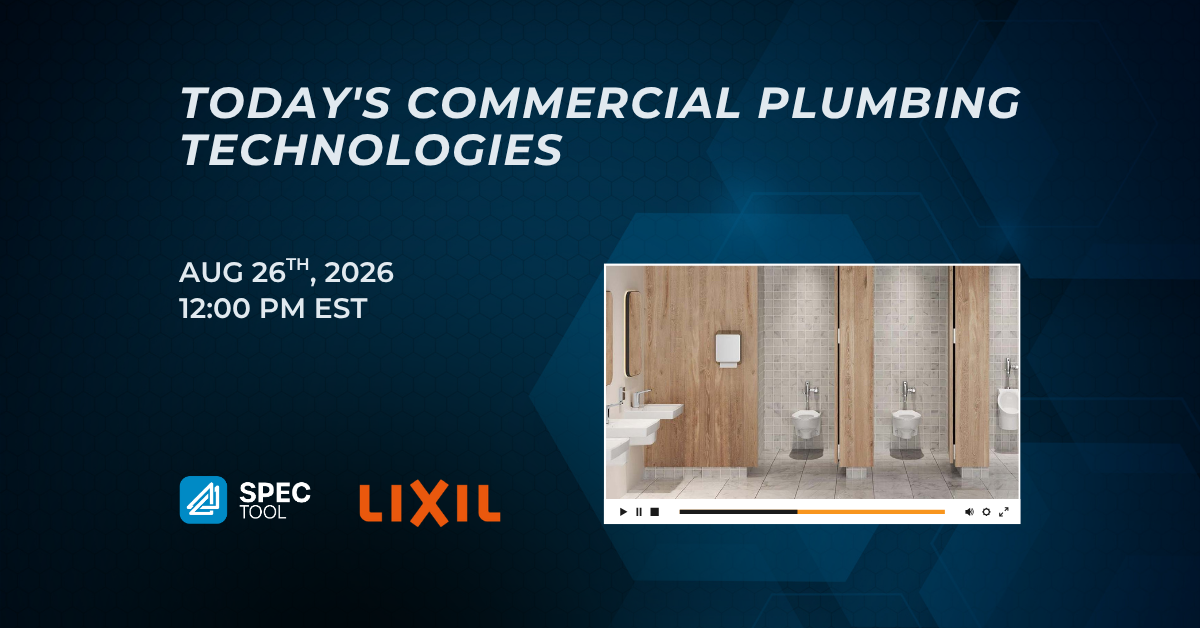
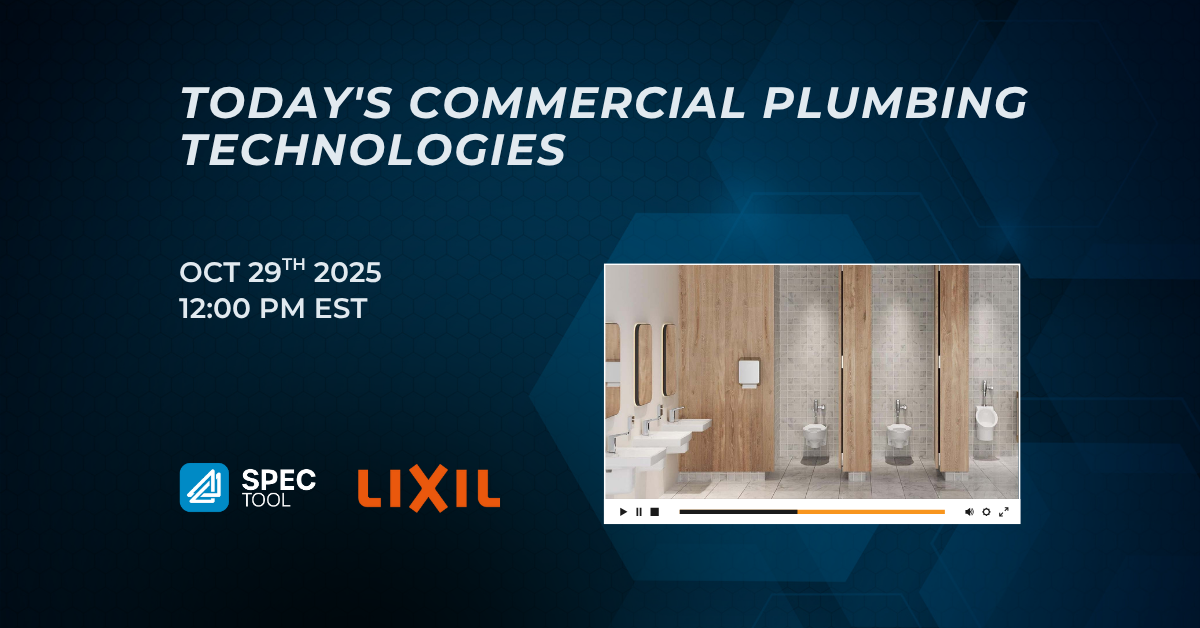
Today’s Commercial Plumbing Technologies with Lixil
Chapter 1 – Intros & CEUs
ATS is a free spec/configuration tool that helps designers pick, configure, and document products, then download specs, schedules, and Revit files.2. The webinar is CEU‑accredited via CEU Events, with certificates and easy online registration.3. LIXIL (American Standard, GROHE, DXV) is the manufacturer side; this session focuses on commercial plumbing, not residential.—
Chapter 2 – Toilet Performance & WaterSense
MAP testing uses soybean paste “logs” to rate how much waste toilets can reliably clear, up to 1,000 g.2. Modern 1.28–1.6 gpf toilets can outperform old 3.5–5 gpf models thanks to better engineering.3. WaterSense toilets use $$\le 1.28$$ gpf, cut water use by at least 20%, and can save ~13,000 gallons and about $140 per toilet per year.
Chapter 3 – Urinals & Waterless vs. Low‑Flow
Commercial urinals today range from 0.5 gpf down to 0.125 gpf (“pint flush”), yielding big savings in high‑use buildings.2. Waterless urinals need special piping, hot‑water flushing, and cartridge changes, often causing odor, crystallization, and higher maintenance costs.3. A good 0.125 gpf urinal usually delivers major water savings with far fewer maintenance issues than waterless units.
Chapter 4 – Ceramics & User Experience
Some bowls use a baked‑in antimicrobial glaze that slows stain and odor‑causing bacteria, keeping surfaces cleaner longer.2. A larger, higher water spot reduces exposed china, so less waste sticks and cleaning is easier.3. Design tweaks like condensation channels, concealed traps, and stronger manifolds cut floor messes and increase load capacity in public restrooms.
Chapter 5 – Gravity vs. Pressure‑Assist & Urinal Shapes
Modern gravity toilets can match or beat pressure‑assist performance while being much quieter, especially in hotels.2. New architectural urinals with concave back walls improve wall wash and reduce splash at very low flows (down to 0.125 gpf).3. Siphon models favor compact retrofits and cost, while blowout models are most powerful but loud.
Chapter 6 – Flush Valves & Sensors
Both piston and diaphragm valves can waste a lot of water if the small refill orifice clogs; designs that protect/clean this orifice last longer.2. Pistons give consistent, time‑controlled flow and excel at low pressure; diaphragms handle high‑pressure spikes better but wear and stretch over time.3. Touchless IR sensors pulse frequently, detect presence, and can be programmed (range, volume, “stadium mode”) for hygiene and water savings.
Chapter 7 – Power & Faucets / Scald Protection
Sensors can be battery‑powered (CRP2), hard‑wired, or run from multi‑AC transformers that feed many flush valves and faucets.2. Turbine power can self‑recharge from flow but is a poor fit for rarely used fixtures.3. New “Smart Therm” faucets integrate the ASSE 1070 thermostatic element into the body, eliminating separate under‑sink mixing valves and simplifying safe installations.
Chapter 8 – ATS Spec Tool & Wrap‑Up
ATS lets firms build reusable “masters” (by building type), then drag‑and‑drop coordinated fixture chains into projects in minutes.2. Projects can output coordinated Revit families, CSI specs, schedules, and submittals, and ATS flags discontinued products so specs stay current.3. The webinar recording lives in the ATS Learning Hub, and follow‑up firm trainings (virtual or in‑person) plus CEU certificates are available.