
How Canada’s new faucet and showerhead efficiency requirements will affect product availability, manufacturer offerings, and plumbing specifications after July 1, 2026
Canada’s plumbing specification landscape is entering an important regulatory transition. With NRCan Amendment 18 introducing new efficiency requirements for faucets and showerheads manufactured on or after July 1, 2026, engineers, architects, specifiers, manufacturers, reps, and distributors should begin reviewing affected product selections now.
While the change may appear to be a simple flow-rate update, the impact is broader. These new requirements will influence which products are available in the Canadian market, how manufacturers manage product offerings, how master specifications are maintained, and how design teams select compliant fixtures for upcoming projects.
For plumbing professionals, the key message is clear: specifications that include higher-flow faucets or showerheads should be reviewed before projects move from design to procurement.
What Is NRCan Amendment 18?
Amendment 18 is part of Canada’s Energy Efficiency Regulations, which establish energy efficiency standards, testing requirements, reporting obligations, labelling, and verification mark requirements for regulated products.
For faucets and showerheads, the new requirements apply to affected products manufactured on or after July 1, 2026. These products may require updated energy efficiency reporting, verification marks, and import reporting where applicable.
This distinction is important. The regulation is tied to the product’s manufacture date, not simply the date a project was designed. A product specified today may not be purchased until after the new requirements take effect. As a result, project teams should begin reviewing commonly specified fixtures, master specifications, approved alternates, and manufacturer data now.
What Changed Under NRCan Amendment 18?
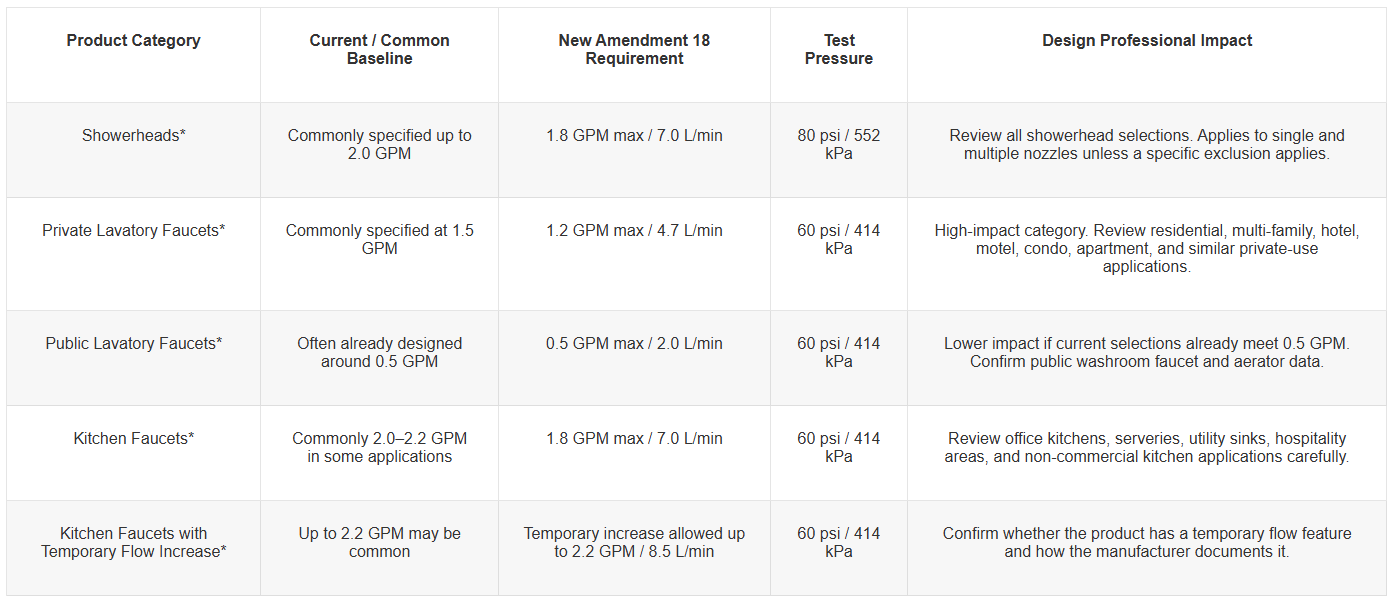
*See detailed exclusions below. Some products may be excluded when they are designed and marketed exclusively for specific applications, including health care, emergency washing, pot fillers, low-pressure water dispensers, or industrial, commercial, and institutional kitchens.
Application Notes for Design Professionals
NRCan Amendment 18 affects two common plumbing fixture categories: showerheads and faucets.
Showerheads
- Showerheads are broadly affected unless a specific exclusion applies, such as products designed and marketed exclusively for emergency washing or health care facilities.
Faucets
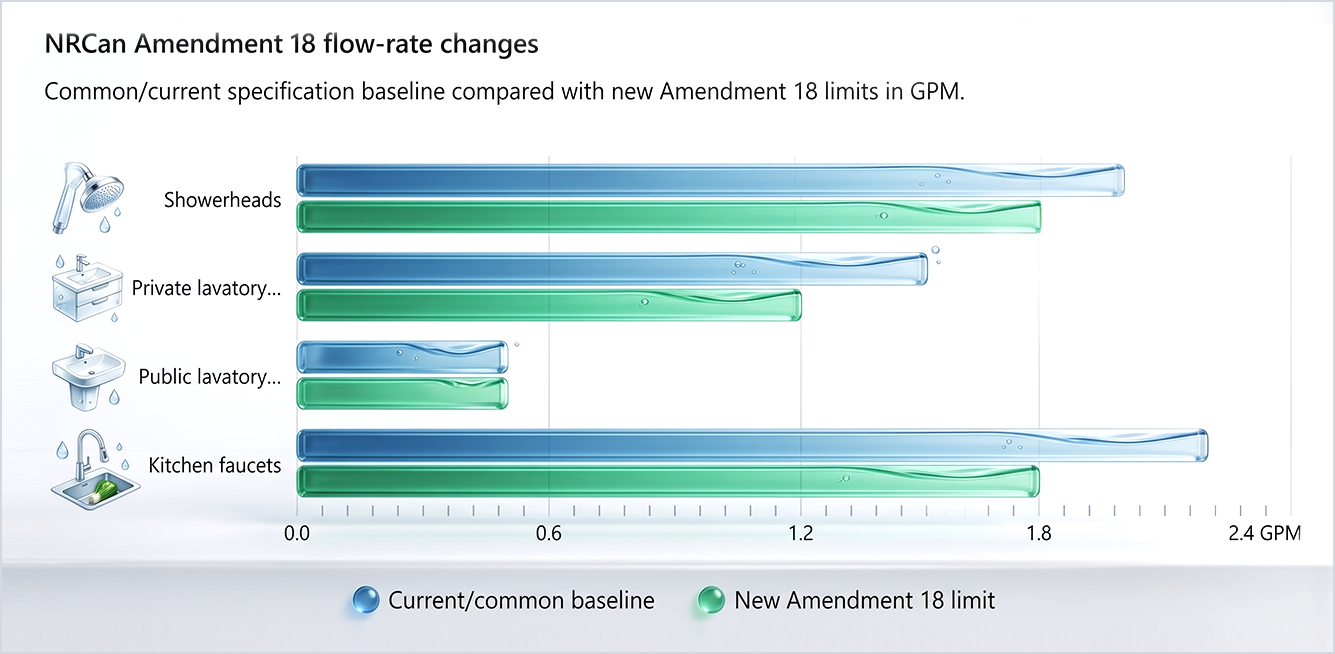
- Private Lavatory Faucets – one of the highest-impact categories because many private lavatory faucets have commonly been specified at 1.5 GPM, especially in residential, multi-family, hotel, motel, condominium, and apartment applications.
- Public Lavatory Faucets – should be confirmed against the 0.5 GPM requirement, especially for commercial and public-facing washroom applications.
- Kitchen Faucets applications may require closer review, especially for office kitchenettes, serveries, cafés, hospitality spaces, utility sinks, and food-service-related areas. Manufacturer documentation should confirm whether an exclusion applies.
Important Exclusions to Understand
Not every product in these categories is treated the same way. Amendment 18 includes specific exclusions, but exclusions should not be assumed based only on where a product is installed. The product should be designed and marketed for the excluded use, and the manufacturer’s documentation should support that application.
Products that may be excluded include:
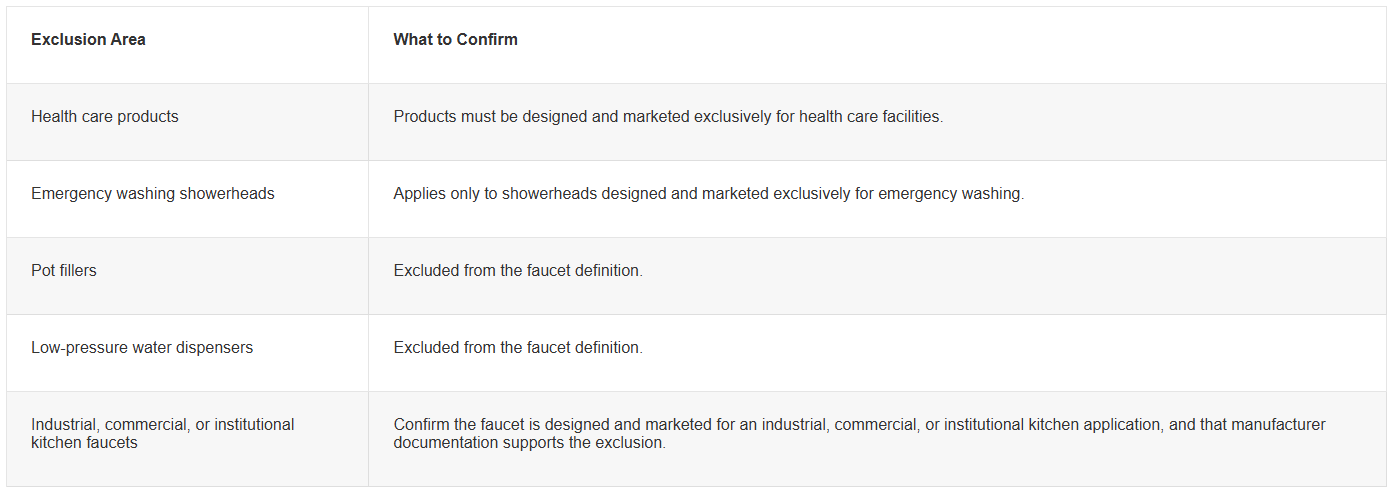
The phrase “designed and marketed exclusively” is important. A product should not be treated as excluded simply because it is being used in a certain project type. The manufacturer’s product positioning, documentation, and intended application should support the exclusion.
Why This Matters to Manufacturers
For manufacturers, Amendment 18 is not only a compliance issue. It may also require product portfolio updates, revised Canadian availability, updated specification sheets, new compliant models, discontinued SKUs, and clearer application guidance.
Manufacturers may need to:
- Review existing faucet and showerhead SKUs against the new Canadian requirements.
- Identify models that may no longer be suitable for affected Canadian applications.
- Update Canadian product catalogues and digital product data.
- Confirm compliant replacement options.
- Provide updated technical documentation, flow-rate data, and verification information.
- Clearly identify products that are designed and marketed exclusively for health care, emergency washing, or other excluded uses.
- Communicate affected products and recommended alternatives to reps, distributors, specification platforms, and design firms.
Accurate product data will become increasingly important. If flow rate, pressure, fitting type, aerator type, or application-specific designation is missing or outdated, it may create confusion for specifiers and downstream risk for projects.
Why This Matters to Engineers, Architects, and Specifiers
For design professionals, the risk is not simply that a product may be “non-compliant.” The greater concern is that a product selected during design may no longer be available, appropriate, or recommended by the time the project reaches the procurement stage.
This is especially important for projects with long design and construction timelines. A faucet or showerhead selected before July 1, 2026, may not be purchased until after the new manufacturing requirements are in effect.
Specifiers should pay close attention to:
- Canadian projects currently in design
- Firm master specifications
- Project templates
- Frequently used faucet and showerhead, families
- Approved alternates
- Private vs. public lavatory applications
- Health care exclusions
- Kitchen faucet applications
- Manufacturer product updates and discontinuation notices
For firms with large master specifications, this is an opportunity to proactively clean up product selections and avoid future rework.
How ATS Can Help
ATS can support manufacturers, engineers, architects, and specifiers through a combination of product data, specification intelligence, and proactive project support.
Through ATS SpecTool and the ATS SpecTeam, firms can identify affected products, review master specifications, and update selections with compliant alternates. Manufacturers can also work with ATS to ensure product data, flow rates, documentation, and replacement recommendations are accurate and accessible to the design community.
Recommended support areas include:
- Product impact reports
- Firm master reviews
- Specification updates
- Compliant alternate recommendations
- Manufacturer data updates
- In-platform compliance notices
- Educational webinars and campaigns
- Project-specific product review support
By combining accurate product data with practical specification guidance, ATS can help the industry move through Amendment 18 with clarity and confidence.
Specification Accuracy Starts Before Procurement
NRCan Amendment 18 is an important reminder that specification accuracy depends on more than product performance. It depends on current regulations, verified manufacturer data, project application, and product availability.
For manufacturers, now is the time to prepare compliant product offerings, update documentation, and communicate clearly with the market.
For engineers, architects, and specifiers, now is the time to review firm masters, update project templates, and confirm compliant alternates.
The best path forward is proactive: educate the industry, flag potential conflicts early, and give design teams the tools they need to specify compliant products with confidence.
FAQ
When do the new requirements apply?
The new requirements apply to affected faucets and showerheads manufactured on or after July 1, 2026.
Does this mean every existing project must be redesigned immediately?
Not necessarily. However, projects that will purchase products manufactured after the effective date should review affected faucet and showerhead selections for compliance, availability, and manufacturer guidance.
Are health care products excluded?
Some products may be excluded if they are designed and marketed exclusively for use in health care facilities. This should be confirmed through manufacturer documentation.
What is the biggest impact of private lavatory faucets?
Private lavatory faucets are limited to 1.2 GPM. This may affect products previously specified at 1.5 GPM in residential, multi-family, hotel, motel, and similar private-use applications.
What is the biggest impact of showerheads?
Showerheads with one or multiple nozzles are limited to 1.8 GPM, unless a specific exclusion applies.
What should firms do first?
Firms should review Canadian master specifications, project templates, frequently specified faucet and showerhead families, and approved alternates.
Helpful Links:
- Need help with your master specification templates? Email us, and our trained professional specification experts are ready to help.
- Watch our Tutorial Videos for Updating Your Master Templates
- Spec Tool Release Notes: Enhanced Master Management & Role-Based Access
Share this article
