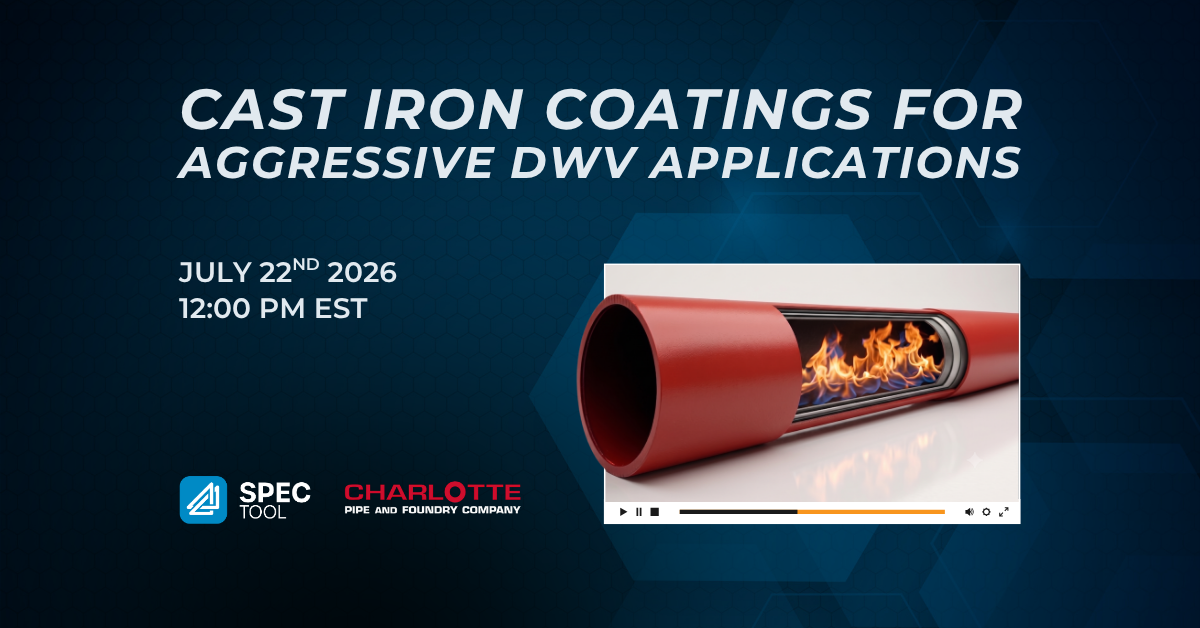
Cast Iron Coatings for Aggressive DWV Applications with Charlotte Pipe
Chapter 1: History and Durability of Cast Iron Piping
- Centuries-long reliability: Cast iron has been used successfully for hundreds of years, with historical systems like the 1664 Palace of Versailles fountains and the 1881 Smithsonian plumbing still functional or meeting standards today.
- High sustainability: Domestic cast iron is highly sustainable, manufactured using 96% post-consumer recycled scrap iron and being 100% recyclable.
- Modern DWV applications: In modern construction, cast iron is primarily used for non-pressure sanitary drain, waste, and vent (DWV) or storm drainage systems.
Chapter 2: Mechanical Joint (MJ) Installation and Torque Requirements
- Proper placement: Mechanical joint (MJ) couplings utilize a neoprene gasket inside a stainless steel shield, requiring proper alignment at the center stop (or using locator lugs) to ensure equal coverage.
- Torque specifications matter: Standard-duty couplings require 60 inch-pounds of torque, while heavy-duty couplings generally require 80 to 120 inch-pounds.
- Strict tightening sequences: Heavy-duty couplings require specific manufacturer-defined tightening sequences and torque settings to prevent leaks.
Chapter 3: Evolving DWV Environments & The Need for Enhanced Coatings
- Expanding pH extremes: Changing facility dynamics—such as low-flow fixtures and harsh undiluted cleaning chemicals—have expanded drainage fluid pH levels beyond the standard range.
- Corrosion from off-gassing: Accumulated solids in low-flow lines off-gas to form hydrogen sulfide, which creates corrosive sulfuric acid that attacks the 12 o’clock position of metallic pipes.
- Enhanced coating capabilities: Enhanced coated cast iron systems expand material resistance to handle aggressive DWV fluids ranging across a pH scale of 1 to 13.
Chapter 4: Alternate Piping Materials vs. Enhanced Cast Iron
- Plastic temperature limitations: Standard PVC loses tensile strength as temperature rises and is limited to $60^\circ\text{C}$, whereas cast iron handles up to $100^\circ\text{C}$.
- CPVC vulnerability: While CPVC offers high chemical resistance, it is susceptible to stress-cracking from fats, oils, and greases (FOG) common in commercial kitchens.
- Adhesion and application: Enhanced cast iron (such as electrocoated systems) provides superior internal/external bonding against delamination without needing special MJ couplings.
Chapter 5: Strategic Application & The ATS Spec Tool
- Targeted deployment: Enhanced coated cast iron costs roughly 25% more than standard iron; therefore, it should be specified targetedly (e.g., healthcare, commercial kitchens, dialysis wards) rather than across an entire building.
- Simplified specification: The ATS Spec Tool allows designers to quickly configure standards-compliant cast iron piping systems and drag-and-drop approved materials into project packages.
- Automated updates: Building projects through the Spec Tool provides automated notifications regarding product updates, model changes, or specification changes up until the project bid date.