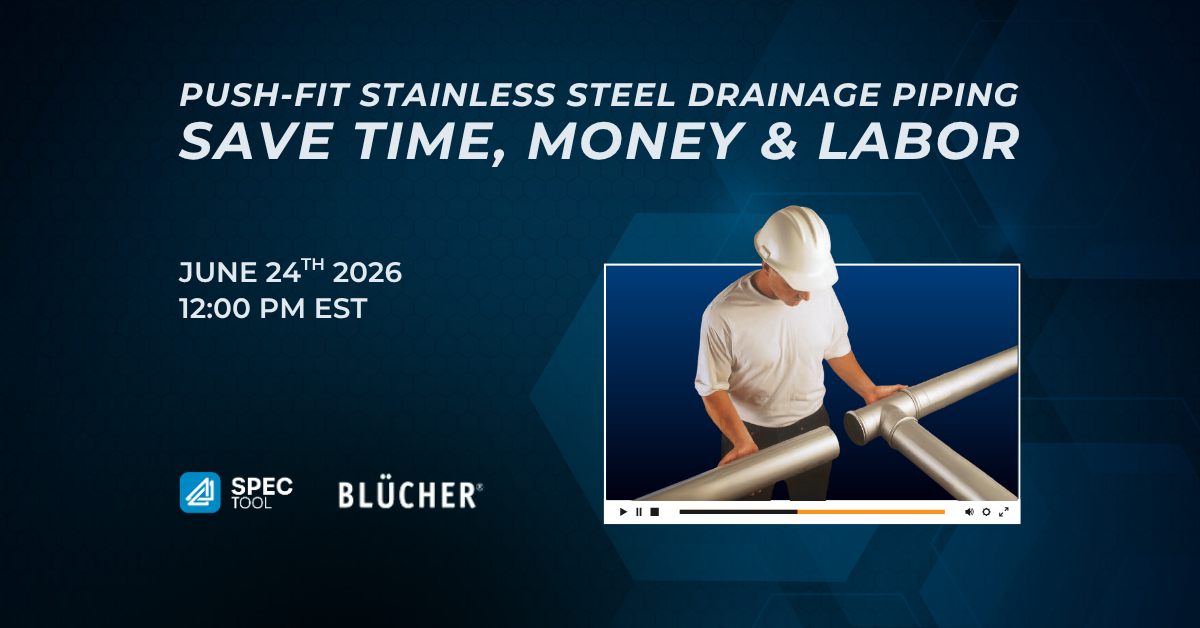
Push-Fit Stainless Steel Drainage Piping: Save Time, Money & Labor with BLÜCHER
Chapter 1: Introduction to the ATS Spec Tool & Blücher Stainless Steel
This chapter introduces the ATS Spec Tool—a free configuration resource for designers—and highlights the origin and global footprint of Blücher (a Watts brand company) specializing in stainless steel drainage.
- Free Configuration Utility: The ATS Spec Tool provides free, accurate product selection and configuration for designers, backed directly by manufacturers.
- Plumbing Roots to Global Scale: Blücher was founded in Denmark in 1965 by a plumber who fabricated his own shower drain; it has since expanded into a worldwide brand spanning multiple continents.
- Versatile Product Application: The Blücher catalog consists of area drains, trench/channel drains, and lightweight pipes/fittings used globally across commercial, industrial, and marine sectors.
Chapter 2: The Critical Importance of Hygiene & Core Applications
Focusing heavily on industrial and specialized sectors, this section highlights why stainless steel is mandatory for hygiene-focused facilities trying to avoid dangerous microbiological contamination.
- Devastating Bacteria Impact: Using proper drainage prevents severe financial and public health disasters, such as the major Listeria outbreak and subsequent plant rebuilds faced by Maple Leaf Foods.
- Mitigating Floor Failures: Traditional drainage materials expand at different rates than concrete, causing floor separations and cracks that trap bacteria; pressurized washdowns create hazardous aerosols out of these pockets.
- Crucial Industrial Sectors: Due to its non-combustible nature, lightweight design, and resistance to corrosion or sea air, Blücher products are highly sought after in pharmaceutical plants, food processing plants, breweries, and the marine/shipbuilding markets.
Chapter 3: Material Limitations & Blücher’s Intelligent Design Solutions
This section contrasts standard drainage materials (PVC, CPVC, Cast Iron) with stainless steel, detailing the specific engineering benefits of the Blücher Hygienic Pro line.
- Traditional Material Risks: PVC softens under standard $180^\circ\text{F}$ cleaning temperatures , CPVC degrades when exposed to food proteins and oils , and cast iron creates rough internal surfaces that harbor bacterial biofilms.
- Hygienic Pro Hydraulic Efficiency: The line features a rounded-off V-shape channel that maximizes water velocity to effortlessly flush away solids using significantly less water than standard channels.
- Structural Floor Bonding: Blücher channels integrate stamped, opposing anchor tabs that lock permanently into concrete like tree roots, along with a blue construction cover that leaves a perfect keyway for seamless flooring material seals.
Chapter 4: Labor Economics & the ATS Spec Tool Ecosystem
The final chapter explores the real-world financial benefits of thin-wall push-fit stainless steel over traditional piping, while wrapping up with a tutorial on creating dynamic specifications via the ATS software.
- Drastic Labor Reductions: An independent RS Means time-and-motion study proved that Blücher’s lightweight push-fit system installs up to 71% faster than cast iron and 62% faster than PVC, easily offsetting higher initial material costs.
- Elimination of Field-Welding Risks: Prefabricated push-fit joints avoid the corrosion hazards of on-site welding (where pickling and passivating the interior of the pipe is nearly impossible) and incorporate alcohol-based lubricants for easy alignment adjusting.
- Streamlined Spec Generation: Designers can seamlessly drag-and-drop Blücher templates into Master project folders via ATSpec.com, instantly auto-generating completely configured submittals, schedules, and CSI 3-part specs.